Why Is the DOT Doctor Asking for a Medical Clearance?
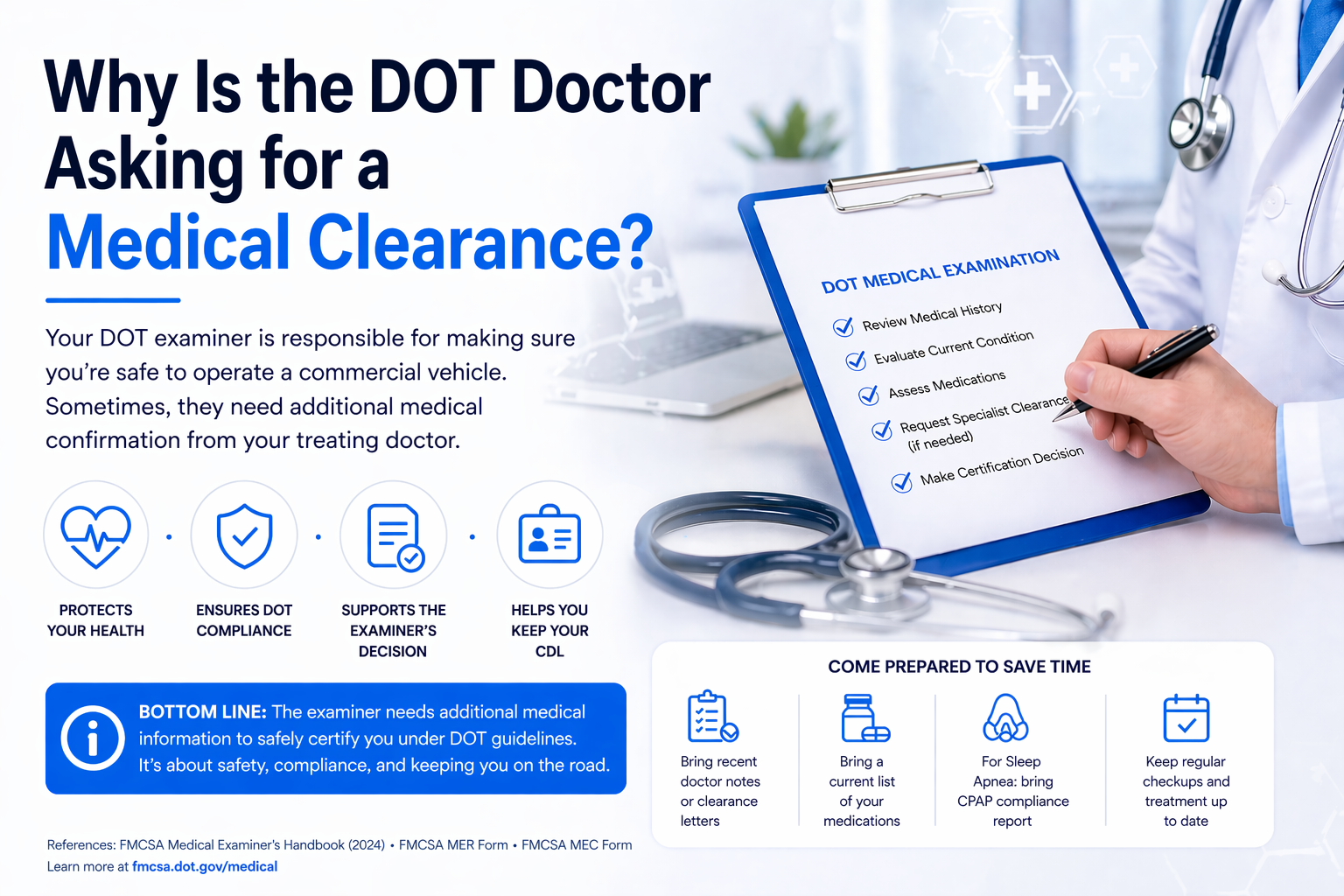
One of the most frustrating surprises for CDL drivers is hearing, “We need a medical clearance from your doctor.” If you have passed before, it can feel confusing. In most cases, though, it does not mean you automatically failed. It means the DOT medical examiner needs more medical information before making the certification decision.
🎧 Listen to the Audio Summary
The DOT examiner is responsible for the decision
Under FMCSA rules, the medical examiner is the person responsible for making the medical certification determination. Specialists and treating doctors can provide helpful records and opinions, but the final certification decision still belongs to the certified examiner performing the DOT physical.
That is why the examiner may pause and ask for additional documentation when they believe more information is needed to decide whether you are safe to drive.
When a medical clearance is usually requested
A clearance letter is commonly requested when the examiner believes a condition could affect safe driving, requires ongoing monitoring, or needs specialist involvement. The request is often about documentation, not punishment.
Heart conditions
Stents, heart attack history, chest pain, irregular heartbeat, cardiac procedures, or follow-up with a cardiologist may trigger a request for clearance.
Sleep apnea
If you use CPAP or appear at risk for sleep apnea, the examiner may ask for a compliance report or sleep specialist documentation.
Neurological history
Seizure history, fainting episodes, head injury, stroke, or other neurological concerns may require more information from a neurologist.
Certain medications
Medications that can cause sedation, slowed reaction time, or impairment may lead the examiner to request a note from the prescribing provider.
Blood pressure or diabetes
If readings are elevated, unstable, or treatment is changing, the examiner may want confirmation that the condition is under control.
Recent surgery or hospitalization
After surgery, hospitalization, or a major medical event, the examiner may want a release showing you are stable and safe to return to duty.
Why now, if you never needed it before?
This is one of the biggest frustrations drivers have. A request for clearance does not always mean something dramatic changed. Sometimes it is simply a matter of the examiner wanting more current proof.
- Different examiner: Different certified examiners may use different clinical judgment when they review the same history.
- Stronger documentation standards: FMCSA guidance places a lot of emphasis on current records and supporting information.
- Your health history changed: Even a small change in treatment, symptoms, or medication can matter.
- Liability concerns: The examiner is responsible for the certification decision and has to protect their license and public safety.
What does a medical clearance letter actually do?
A medical clearance letter is usually your treating doctor or specialist saying that your condition is stable, being monitored, and does not prevent safe operation of a commercial motor vehicle based on the information they know.
It helps the examiner by filling in the details that may not be obvious during a routine office visit.
| What the examiner needs | How the clearance letter helps | Why it matters to the driver |
|---|---|---|
| Confirmation of diagnosis | Explains what condition you have and whether it is stable | Reduces uncertainty and helps prevent delays |
| Treatment details | Shows medications, compliance, follow-up care, and specialist oversight | Helps the examiner understand your real-world medical status |
| Safety assessment | Supports whether the condition is likely to interfere with safe driving | Can help the examiner make a confident certification decision |
| Return-to-duty status | Shows whether you are released to work without restrictions or with relevant updates | May help you get your card faster once the paperwork is received |
What drivers should bring to avoid delays
The best way to prevent return visits is to bring useful documentation the first time if you already know you have a condition that often raises questions.
- Bring a current medication list. Include dosage and prescribing doctor if possible.
- Bring recent doctor notes. Especially if you are followed by a cardiologist, neurologist, sleep specialist, or endocrinologist.
- Bring a clearance letter if you already have one. This can save time if your condition commonly triggers review.
- Bring CPAP compliance reports if applicable. Sleep apnea is one of the most common reasons drivers are delayed.
- Bring discharge paperwork after surgery or hospitalization. If you recently had a procedure, the examiner may want proof that you are stable.
- Do not assume the examiner can “just use last year’s card.” Each exam is a new certification decision.
Helpful examples CDL drivers run into
Here are a few real-world situations where a clearance request is common:
- A driver had a heart stent placed and feels fine, but the examiner wants cardiology follow-up notes before certifying.
- A driver uses CPAP and brought no report, so the examiner cannot verify compliance that day.
- A driver had a seizure many years ago, but the examiner wants a neurologist to confirm ongoing stability.
- A driver takes a medication that may cause drowsiness, and the examiner wants the prescribing doctor to document that it is safe.
- A driver recently changed blood pressure or diabetes medication, and the examiner wants proof that treatment is stable.
Does needing a clearance mean you failed?
Not necessarily. In many cases, it simply means the examiner has not made the final decision yet. Once the requested records are reviewed, many drivers are still certified.
The key issue is timing. If you know your medical card is close to expiration, do not wait until the last minute if there is any chance you may need additional paperwork.
FMCSA references
- FMCSA: Medical Examiner Responsibilities
- FMCSA Guidance: Who Is Responsible for Ensuring Medical Certifications Meet Requirements?
- FMCSA: Medical Examination Report (MER) Form, MCSA-5875
- FMCSA: Medical Examiner’s Certificate (MEC), Form MCSA-5876
- FMCSA: Medical Examiner’s Handbook 2024 Edition
- FMCSA: National Registry of Certified Medical Examiners
Need a DOT physical in Orlando?
If you have a medical condition and want to avoid surprises, it helps to come prepared. Bring your medication list, recent specialist notes, and any available clearance letters so the examiner has what they need to make a decision.
Call: 407-859-1880 • Location: 4985 Hoffner Ave, Suite 1, Orlando, FL 32812