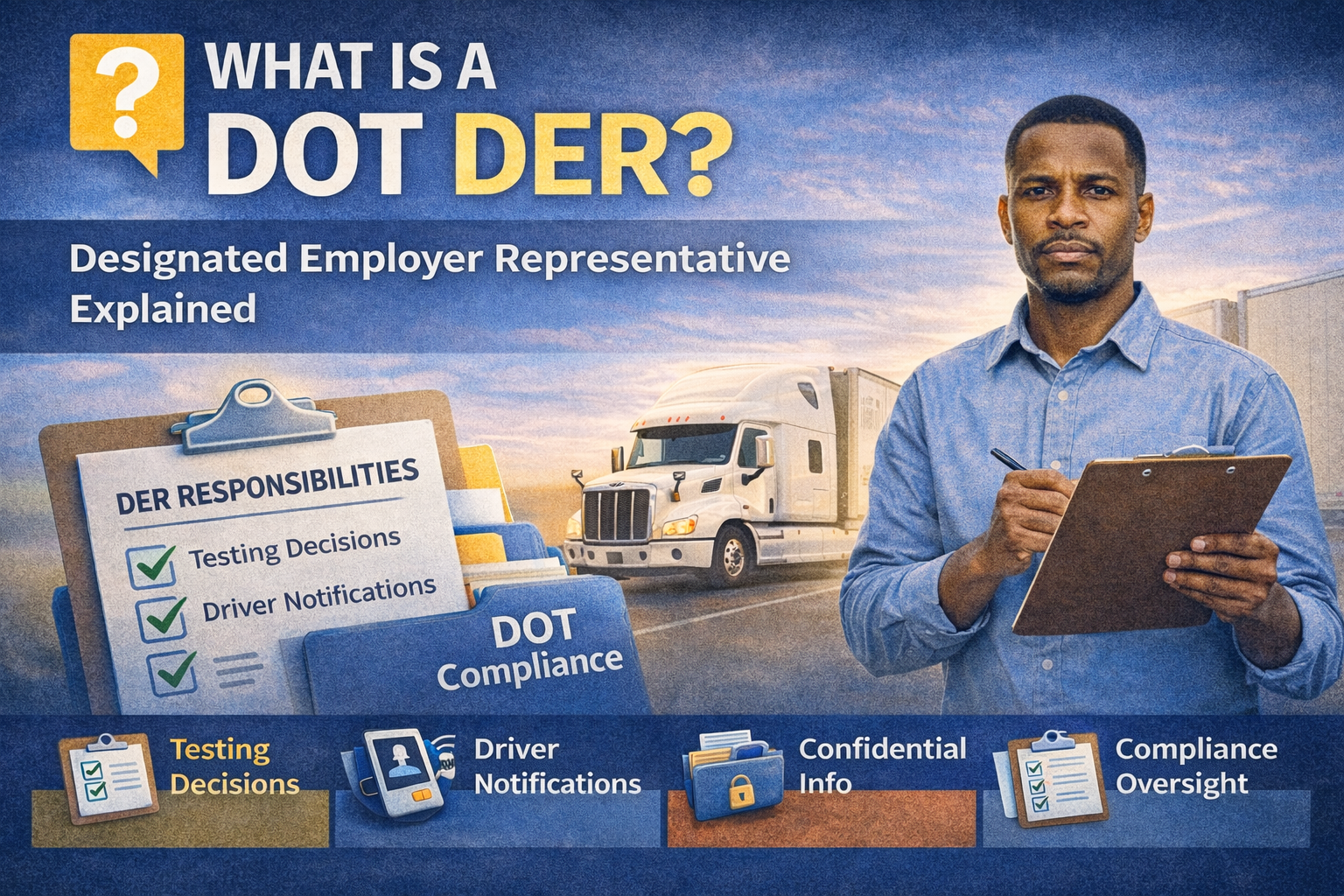
What Is a DOT DER? Designated Employer Representative Explained
If your company has CDL drivers in a DOT drug and alcohol testing program, you need to know what a DER is. The Designated Employer Representative is the employer’s key decision-maker for testing matters, confidential communications, and day-to-day DOT program oversight.
🎧 Listen to the Audio Summary
What is a DER?
DER stands for Designated Employer Representative. In a DOT drug and alcohol testing program, this is the company person who acts on behalf of the employer for important testing and compliance matters.
The DER is not just a contact name on paper. This person needs real authority to make decisions, receive confidential information, and take action when required under federal regulations.
Why does an employer need a DER?
Every employer with covered CDL drivers needs a clear point of responsibility for the company’s DOT drug and alcohol testing program. Without a DER, important notifications, testing decisions, and compliance steps can get missed.
For the employer
The DER keeps the company organized, receives program communications, and helps make sure required actions are handled promptly.
For the driver
The DER is often the company person who gives testing instructions, communicates next steps, and handles program-related issues.
What authority should a DER have?
A DER must have authority to act for the employer when something important happens in the testing program. That includes situations where a driver may need to be removed from safety-sensitive duties or where the employer must respond quickly to a test-related issue.
Can a C/TPA, clinic, or collection site be the DER?
No. This is one of the most important points for employers to understand.
Your collection site, laboratory, MRO, or C/TPA can help administer the program, but they cannot be your DER. The DER must be an employee of your company.
What does the DER actually do?
A DER commonly handles:
| Responsibility | What it means in real life |
|---|---|
| Program communication | Receive updates, notices, and instructions from the program administrator or C/TPA. |
| Driver roster management | Notify the program when drivers are hired, terminated, or removed from safety-sensitive duties. |
| Pre-employment compliance | Make sure required pre-employment drug testing and Clearinghouse steps are completed before driving begins. |
| Random testing administration | Receive confidential selections, notify drivers, and make sure they report promptly. |
| Test authorization | Provide the driver with instructions on where and when to report for testing. |
| Reasonable suspicion response | Coordinate action when reasonable suspicion testing is needed and help ensure supervisors are trained. |
| Recordkeeping and confidentiality | Maintain program records securely and separately from ordinary personnel files. |
| Program oversight | Review results and communications and make sure employer actions are taken when required. |
Helpful examples of what a DER may handle
- A driver is selected for a random test and must be notified immediately.
- A new CDL driver is hired and cannot perform safety-sensitive work until the required pre-employment testing is complete.
- A driver’s status changes and the random pool needs to be updated.
- A collection issue, refusal issue, or other urgent testing matter requires employer action.
- The company needs to maintain secure records and respond to compliance questions.
Does a small company still need a DER?
Yes. Even very small carriers need someone on the employer side who serves in the DER role. In a small business, that may be the owner, office manager, operations manager, or another company official with real authority.
What makes a good DER?
- Understands who is in the testing program
- Can act quickly when testing notifications are received
- Keeps communication clear with drivers and service agents
- Understands the importance of confidentiality
- Tracks hiring, terminations, and driver status changes
- Takes compliance deadlines seriously
Common DER mistakes employers should avoid
Assuming the C/TPA is the DER
A C/TPA can assist with administration, but the employer still needs its own designated representative.
Choosing someone without authority
If the person cannot act for the company, they are not the right fit for the role.
Not updating driver rosters
Outdated rosters can create random testing and compliance problems.
Poor record organization
DOT testing records should be secure and not mixed loosely into general personnel records.
How DER responsibilities connect to compliance
The DER helps the employer keep the program moving, but the employer remains ultimately responsible for compliance. That means having a DER does not shift responsibility away from the company. It helps the company carry it out correctly.
FAQ
What is a DOT DER?
A DOT DER is the Designated Employer Representative — the person authorized to act on drug and alcohol testing matters.
Why does an employer need a DER?
Because someone at the company must receive test-related communications, make required decisions, and help carry out DOT program responsibilities.
Can a clinic or C/TPA serve as the DER?
No. The DER must be a company employee. Service agents cannot serve as the employer’s DER.
Does the DER have to notify drivers selected for random testing?
In many programs, yes. The DER receives the confidential random notice and makes sure selected drivers are directed for testing promptly.
Is the DER responsible for the entire company’s compliance?
The DER helps manage the program, but the employer remains ultimately responsible for complying with DOT rules.
Need help with your DOT program?
HealthRoute helps employers, owner-operators, and motor carriers with drug testing, consortium support, and practical DOT compliance guidance in Orlando.
Call: 407-859-1880 • Location: 4985 Hoffner Ave, Suite 1, Orlando, FL 32812