Urinalysis vs DOT Drug Test: What’s the Difference
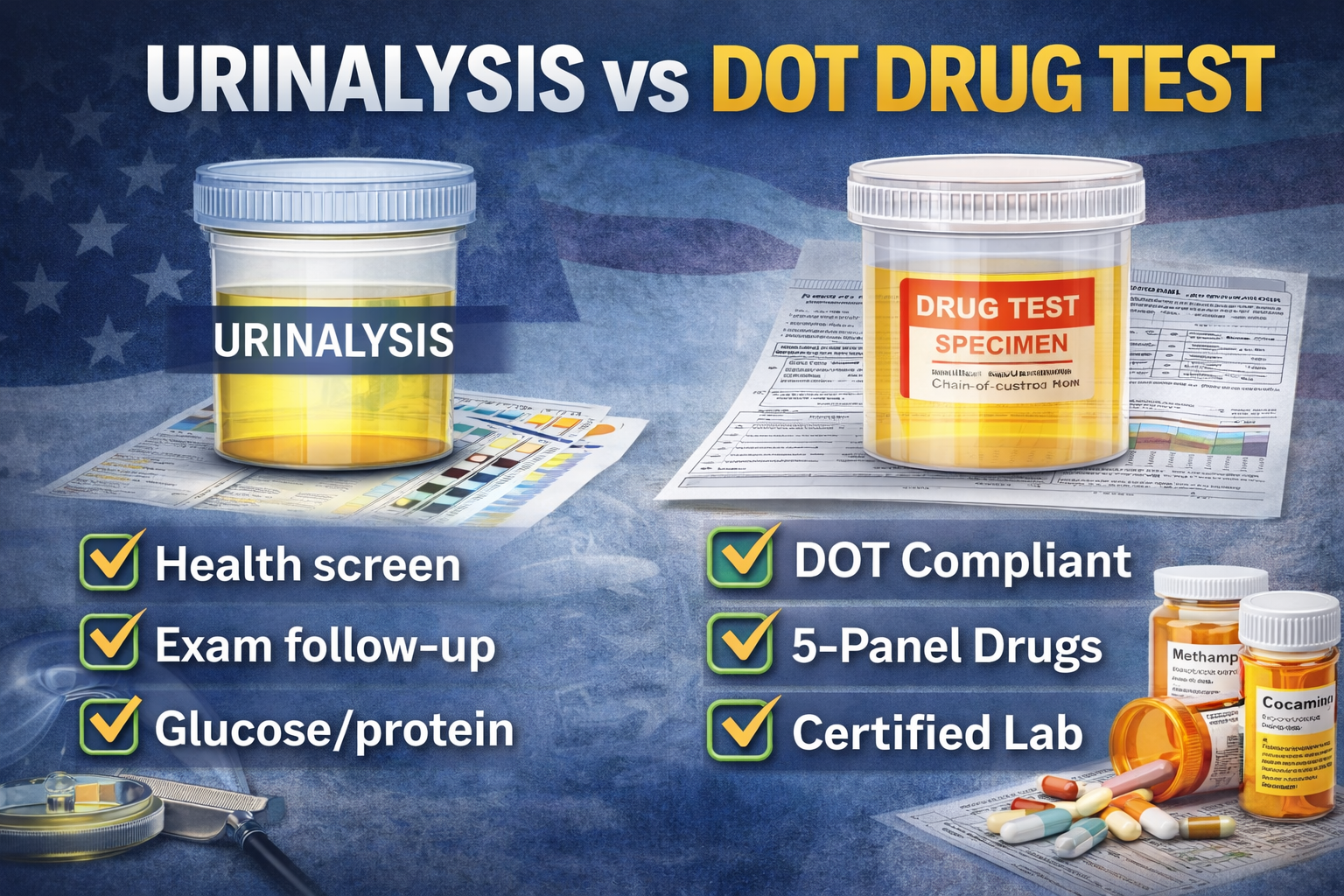
One of the most common driver questions is: “Is the urine test at a DOT physical a drug test?” The answer is no. During a DOT physical, the urine test is a basic urinalysis for health screening. DOT drug testing is a separate program (like random and pre-employment) with strict lab rules and chain-of-custody.
Why doesn’t DOT require a drug test with the DOT physical?
It feels logical to drivers: “If I’m safety-sensitive, why don’t they drug test me at the medical exam?” The reason is that DOT handles medical certification and drug testing as two different compliance systems.
The DOT physical is about whether a driver is medically qualified to operate safely (vision, hearing, blood pressure, medical conditions, etc.). Drug testing is handled under a separate DOT drug & alcohol testing program, which includes testing situations like:
- Pre-employment (before performing safety-sensitive work)
- Random testing (ongoing program for covered drivers)
- Post-accident (when criteria apply)
- Reasonable suspicion (trained supervisor observation)
- Return-to-duty and follow-up (after a violation)
Urinalysis at a DOT physical: what it checks (and why it matters)
During a DOT physical, drivers provide a urine sample for urinalysis. This is a basic health screen — it is not a DOT drug test.
| Urinalysis Item | What it may indicate | Why the examiner cares |
|---|---|---|
| Glucose (sugar) | Possible blood sugar control issue | May trigger follow-up questions about diabetes and safety risk |
| Protein | Possible kidney-related concern (among other causes) | May require medical follow-up depending on the full picture |
| Blood | Possible urinary tract/kidney issue (or other causes) | May be a “red flag” that needs evaluation |
| Specific gravity | Hydration / urine concentration | Helps interpret the sample and hydration status |
What a DOT drug test checks for (and why it’s different)
A DOT drug test is a regulated laboratory test with strict procedures designed to protect accuracy, identity, and integrity. It typically includes a federal 5-panel test for:
- Marijuana metabolites (THC)
- Cocaine metabolites
- Amphetamines (including methamphetamine)
- Opioids
- PCP (phencyclidine)
DOT drug testing is strict for a reason
Chain of custody
DOT tests use a chain-of-custody form and controlled handling so the result is tied to the correct donor.
DOT-certified lab process
DOT testing follows federal procedures, including confirmatory testing and review processes (when applicable), which is why DOT tests are handled differently than general “instant cup” screens.
Why drivers get confused
Both processes may involve urine — but they serve totally different purposes:
- DOT Physical urinalysis = health screening (glucose/protein/blood, etc.)
- DOT drug test = regulated compliance test (lab + chain-of-custody + DOT program rules)
FAQ
Is the urine test at a DOT physical a drug test?
No. The urine test at the DOT physical is a urinalysis for health screening. It is not used as a DOT drug test during the medical exam.
Can I “fail” my DOT physical because of urine results?
Urinalysis can reveal findings that may require follow-up. Whether it affects certification depends on the overall medical evaluation and safety risk assessment.
Do owner-operators need to be in a random drug testing program?
Many owner-operators and small fleets use a consortium/TPA so they have a compliant random testing program with proper documentation.
What’s the biggest difference between a DOT drug test and a regular drug test?
DOT testing follows federal procedures (including chain-of-custody and laboratory processes). It’s designed to be compliant and defensible.
Need a DOT physical or DOT drug testing in Orlando?
HealthRoute provides walk-in DOT physicals and DOT drug testing services in Orlando — and we help employers and owner-operators stay compliant through consortium enrollment.
Call: 407-859-1880 • Location: 4985 Hoffner Ave, Suite 1, Orlando, FL 32812