Stroke or Mini-Stroke (CVA or TIA): Can a CDL Driver Be Certified?
Drivers and employers ask this question often: “Can a CDL driver with a history of stroke or mini-stroke still pass a DOT physical?” The answer is sometimes yes — but FMCSA expects the medical examiner to look carefully at neurologic recovery, seizure risk, treatment stability, and whether the driver can safely perform commercial driving duties.
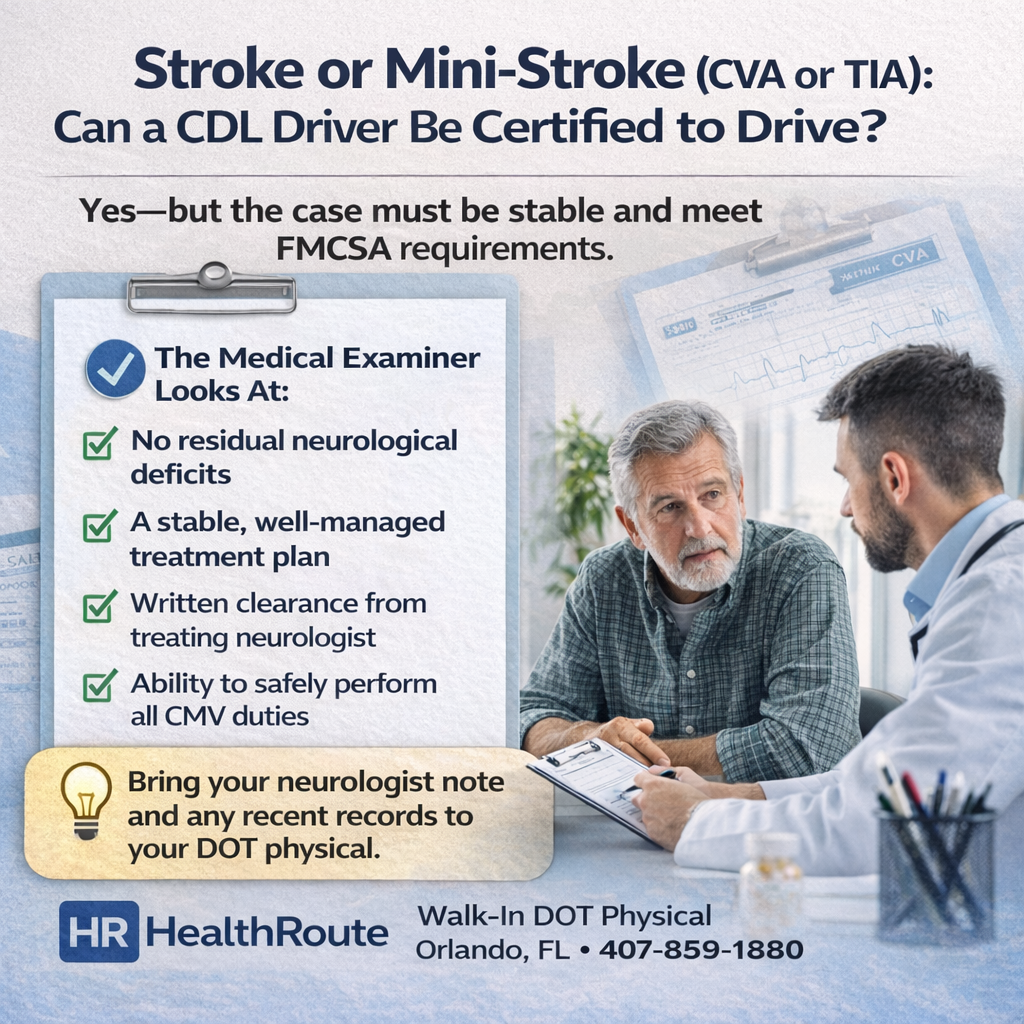
Why FMCSA looks closely at stroke and TIA history
A stroke or mini-stroke can affect the exact skills needed to drive a commercial motor vehicle safely — including judgment, attention, reaction time, vision, strength, and coordination.
FMCSA’s handbook also notes that the risk of another stroke is highest within the first year after a stroke, and that a TIA can be a warning sign for future stroke. That is one reason medical examiners often take a cautious approach after these events.
Can a CDL driver be certified after a stroke or TIA?
In some cases, yes — but certification is not automatic. The medical examiner must decide, case by case, whether the driver meets the physical qualification standard for interstate commercial driving.
- No residual neurological deficits that would interfere with safe CMV operation
- A stable and well-managed treatment plan
- Clear cognitive and physical function for driving duties
- The ability to safely perform all CMV driving duties
- Specialist follow-up when needed, often including neurologist evaluation or written clearance
What does the medical examiner evaluate?
FMCSA specifically points medical examiners toward neurologic assessment areas such as:
Cognitive and mental function
Judgment, attention, concentration, and overall thinking ability matter because commercial driving is a safety-sensitive job.
Physical driving ability
Vision, reaction time, physical strength, agility, and any residual weakness or coordination problems can affect certification.
The examiner may also consider:
- Whether the cause of the stroke or TIA has been clearly identified
- Whether there are lingering neurologic symptoms
- Whether the driver has had any seizures
- Whether the condition could cause loss of consciousness or loss of CMV control
- Whether treatment has been adequate, effective, safe, and stable
Why neurologist clearance can matter
FMCSA says neurologist evaluation may be necessary, especially when the medical examiner needs confirmation about the area of brain involvement, recovery, seizure risk, or lingering deficits.
In real-world practice, a written note from the treating neurologist often helps the DOT exam go much more smoothly.
- A recent note from your treating neurologist or specialist (neurological clearance to drive commercially)
- A current medication list
- Hospital discharge paperwork if the event was recent
- Any imaging or follow-up summary, if available
- Documentation stating whether you have any restrictions or residual deficits
Does a mini-stroke (TIA) count as a serious DOT issue?
Yes. A TIA can still affect DOT certification because it may indicate elevated risk for future stroke. FMCSA notes that roughly one-third of people who have a TIA eventually have a stroke, with about half of those strokes occurring within a year.
That does not mean a driver can never be certified after a TIA. It means the medical examiner will want to be comfortable that the condition is understood, stable, and not likely to impair safe driving.
How long can a driver be certified?
Usually limit certification to one year with history of stroke or TIA, but they can issue a shorter certification interval if closer monitoring is appropriate.
So a driver with stroke or TIA history might receive:
- A shorter card for closer follow-up
- A request for more records before certification
- Or no certification if there are significant deficits or unresolved safety concerns
FAQ
Can a CDL driver with a history of stroke be certified?
Sometimes yes. Certification depends on recovery, neurologic function, seizure history, treatment stability, and whether the driver can safely perform commercial driving duties.
Can a CDL driver with a mini-stroke (TIA) be certified?
Sometimes yes. A TIA does not automatically end certification forever, but it is taken seriously because it may signal increased future stroke risk.
Will I need neurologist clearance after a stroke or TIA?
Often it helps, and in some cases the medical examiner may specifically want specialist evaluation or written clearance before making a decision.
What can disqualify a driver after stroke or TIA?
Residual neurologic deficits, poor cognition, seizure history, unstable treatment, or any condition likely to cause loss of consciousness or loss of vehicle control can create disqualification concerns.
Can I still get a shorter medical card instead of being denied?
Yes, sometimes. The examiner may use a shorter certification interval when closer follow-up is needed and the driver otherwise appears safe to drive.
Need a DOT physical in Orlando?
If you’ve had a stroke or TIA and need guidance on the DOT medical process, HealthRoute can help you understand what documentation to bring and what the examiner may need to review.
Call: 407-859-1880 • Location: 4985 Hoffner Ave, Suite 1, Orlando, FL 32812