CDL Drivers: Lower Blood Pressure With Simple Isometric Exercises
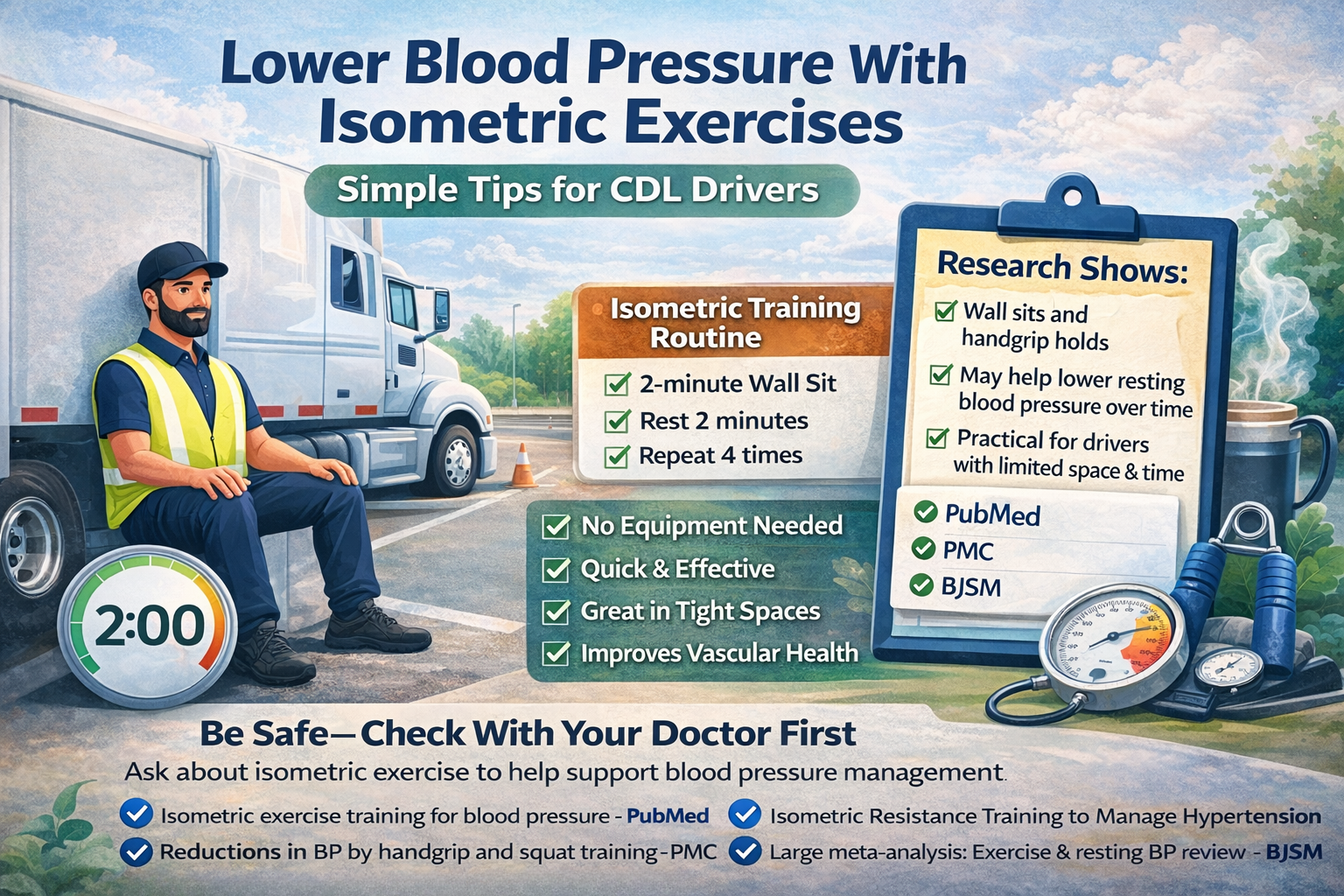
Isometric exercises like wall sits and handgrip squeezes may help lower resting blood pressure over time. For CDL drivers, that matters because these exercises are short, simple, and can be done in limited space.
Why this matters for CDL drivers
CDL drivers often deal with long hours, irregular schedules, limited exercise space, and the stress that comes with staying medically qualified. That is one reason simple exercise strategies are attractive.
Isometric exercises may be especially practical for drivers because they can be done in a small area, usually need little or no equipment, and do not require a full gym workout. A wall sit, for example, can be done against almost any stable wall.
Small-space friendly
Useful for drivers who do not have much room for traditional workouts.
Time-efficient
Short exercise bouts may fit more easily into a busy driving schedule.
What is an isometric exercise?
An isometric exercise is a controlled muscle contraction where you hold tension without a lot of joint movement. Common examples include:
- Wall sits (wall squats)
- Handgrip squeezes
- Planks
- Static holds done with good form
Unlike walking or cycling, these exercises are not based on continuous movement. Instead, the muscle stays engaged during a steady hold.
A simple wall sit routine drivers can ask their doctor about
One practical routine often discussed in isometric training looks like this:
- 2-minute wall sit
- Rest 2 minutes
- Repeat for 4 rounds
This kind of routine is appealing because it is straightforward, requires no special equipment, and may be easier to stick with than a longer workout. That said, drivers should use caution and discuss it with their physician first—especially if they already have high blood pressure, chest symptoms, dizziness, known heart disease, or other medical concerns.
How isometric exercise may help blood pressure
Researchers continue to study the exact mechanisms, but findings suggest isometric training may improve vascular function and help reduce resting blood pressure over time in some adults. Some studies and reviews have found meaningful reductions in systolic and diastolic blood pressure after a period of regular isometric training.
| Benefit | Why it matters for drivers |
|---|---|
| Minimal space needed | Helpful when exercise options are limited on the road or during short breaks |
| No gym required | Wall sits and similar holds can be done almost anywhere with safe footing and a stable surface |
| Brief sessions | May be easier to fit into a packed schedule than longer workouts |
| Simple routine | Drivers may be more likely to stay consistent with a routine that is easy to remember |
Reference studies on isometric exercise and blood pressure
Here are four strong references you can include in the article:
- Isometric exercise training for blood pressure management (PubMed)
- Reductions in systolic blood pressure achieved by isometric handgrip and wall squat training (PMC)
- Isometric Resistance Training to Manage Hypertension (PubMed)
- Exercise training and resting blood pressure: a large-scale pairwise and network meta-analysis of randomised controlled trials (BJSM)
FAQ
Can isometric exercise help lower blood pressure?
Research suggests it may help lower resting blood pressure over time in some adults, especially when performed regularly and appropriately.
Why is this useful for truck drivers?
Truck drivers often have limited space and limited time. Isometric exercise may be practical because it can be done almost anywhere and usually does not require equipment.
Can I do wall sits instead of taking my blood pressure medicine?
No. Exercise should not replace prescribed treatment or physician advice. Drivers should follow their doctor's recommendations.
Should drivers with high blood pressure ask their doctor first?
Yes. That is especially important if you have elevated blood pressure, heart disease, symptoms, or questions about what is safe for you.
Need a DOT physical in Orlando?
If you are working on blood pressure control and need a DOT physical, HealthRoute provides walk-in DOT physicals in Orlando. We can also help answer common questions about blood pressure and certification timelines.
Call: 407-859-1880 • Location: 4985 Hoffner Ave, Suite 1, Orlando, FL 32812