FMCSA SAP Process: What CDL Drivers Should Do After a Positive Drug Test
A positive DOT drug test can feel overwhelming, but there is a defined next step: the return-to-duty (RTD) process. A key part of that process is working with a DOT-qualified Substance Abuse Professional (SAP). Here is what CDL drivers should know.
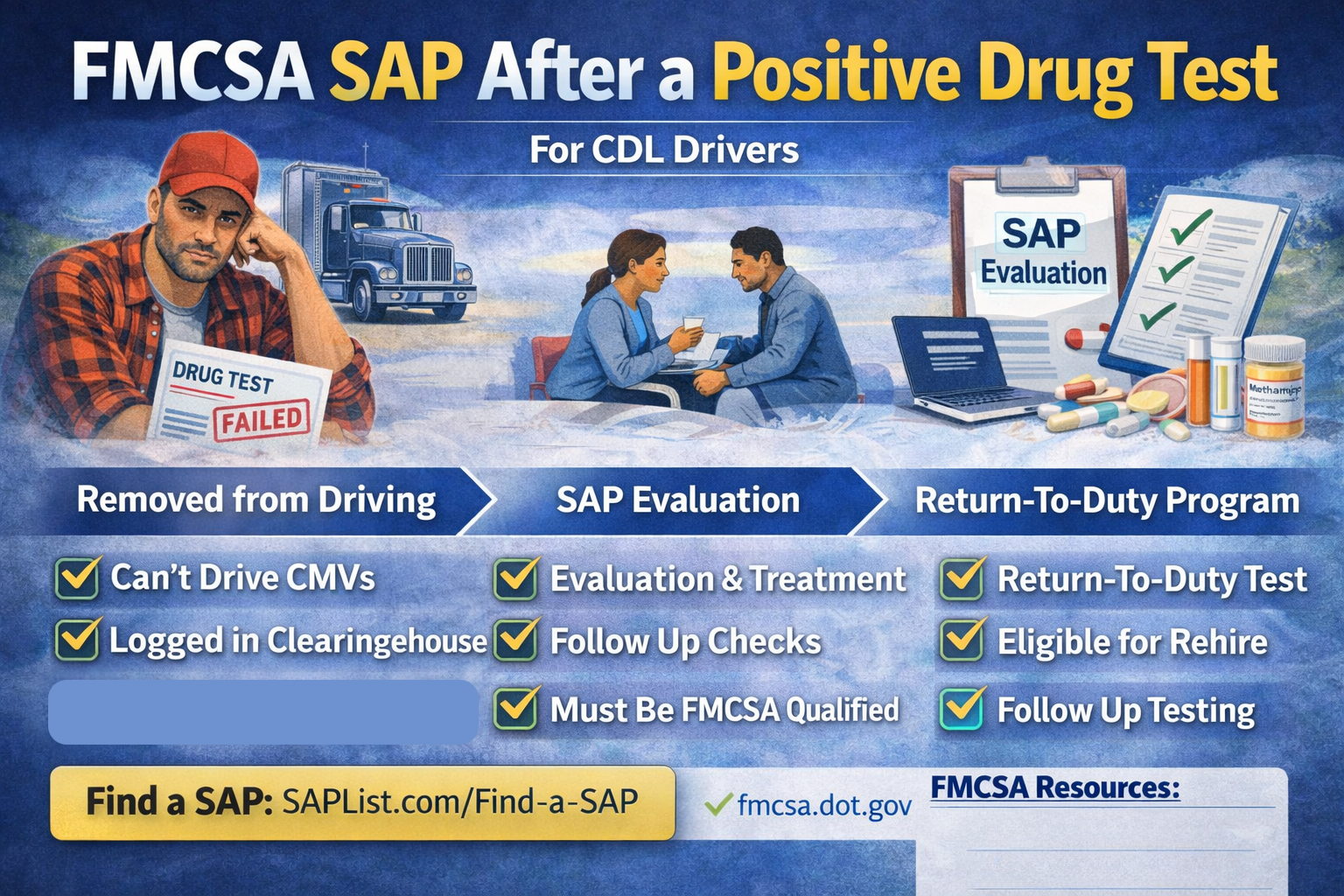
What happens after a positive DOT drug test?
If a CDL driver has a verified DOT drug or alcohol program violation, the driver cannot keep performing safety-sensitive work until the required RTD process is completed. That means the driver cannot simply wait a few days and go back to driving.
Instead, the driver must enter the formal DOT return-to-duty process. This process is designed to make sure the driver is evaluated, completes any required education or treatment, and is properly cleared before returning to regulated duties.
What is a SAP?
A Substance Abuse Professional (SAP) is a licensed or certified professional who has knowledge of alcohol and controlled substance disorders and also understands the DOT return-to-duty process.
The SAP is not just a counselor who signs a paper. The SAP has a specific DOT role in evaluating the driver, making recommendations, determining compliance, and setting the follow-up testing plan.
What the SAP does first
The SAP performs the initial evaluation and recommends the education and/or treatment the driver must complete.
What the SAP does later
After the driver completes the SAP's recommendations, the SAP re-evaluates the driver and decides whether the driver is eligible for return-to-duty testing.
What does the SAP process usually look like?
- The driver has a verified DOT drug or alcohol violation.
- The driver is removed from safety-sensitive functions.
- The driver is evaluated by a DOT-qualified SAP.
- The SAP recommends education, treatment, counseling, or another appropriate plan.
- The driver completes the SAP's recommendations.
- The SAP conducts a follow-up evaluation.
- If compliant, the SAP determines the driver is eligible for return-to-duty testing.
- The employer sends the driver for a return-to-duty test.
- If the return-to-duty test is negative, the driver may return to safety-sensitive work.
- The driver remains subject to the SAP's follow-up testing plan.
| Step | What happens | Why it matters |
|---|---|---|
| Violation | Verified DOT drug/alcohol violation occurs | Driver becomes prohibited from safety-sensitive duties |
| SAP evaluation | Driver meets with a DOT-qualified SAP | The SAP determines what education/treatment is needed |
| Compliance | Driver completes the SAP's recommendations | This is required before RTD testing can move forward |
| RTD test | Employer sends the driver for a return-to-duty test | The driver must have a negative RTD test before returning |
| Follow-up testing | SAP sets the follow-up testing plan | The driver remains under additional testing requirements |
Who sends the driver for the return-to-duty test?
The return-to-duty test must be sent by the driver’s current employer. During the follow-up period, any employer employing that driver must complete the follow-up testing plan as specified by the SAP.
How long does follow-up testing last?
The SAP prescribes a series of follow-up tests over a period of one to five years. That means finishing treatment does not mean the process is completely over. The driver may still have follow-up testing obligations for a significant time afterward.
What does the Clearinghouse have to do with it?
The FMCSA Drug & Alcohol Clearinghouse tracks certain RTD-related information for CDL drivers. Drivers can view their own Clearinghouse records, and SAPs must report certain RTD milestones in the Clearinghouse.
Before a SAP can enter RTD information for a driver, the driver must designate that SAP in the Clearinghouse.
- Register in the Clearinghouse so you can access your record
- Designate your SAP in the Clearinghouse if needed
- Monitor your status during the RTD process
- Keep copies of important paperwork for your records
How do I find a SAP?
DOT rules require the employer to provide the driver with a list of qualified SAPs, but the driver may also choose a SAP based on their own research.
One directory many drivers use is: Find a SAP on SAPlist
On that page, drivers can search by nearest location, city/state/ZIP, or last name.
Helpful advice for CDL drivers going through the SAP process
- Do not assume one counseling visit clears you to drive again
- Choose a DOT-qualified SAP, not just any counselor
- Respond quickly to paperwork requests and appointments
- Stay in contact with your employer or C/TPA if applicable
- Check your Clearinghouse status instead of guessing where you stand
- Understand that the RTD test and follow-up plan are separate steps
Official references
- FMCSA: Substance Abuse Professionals
- FMCSA Clearinghouse: The Return-to-Duty Process
- FMCSA Clearinghouse: How to Designate a SAP
- SAPlist: Find a SAP
FAQ
Can I go back to driving after a positive DOT drug test if I pass another test later?
No. A CDL driver must complete the DOT return-to-duty process, including the SAP process and a negative return-to-duty test, before returning to safety-sensitive work.
Is a SAP the same as my regular therapist or counselor?
Not necessarily. The driver needs a DOT-qualified SAP who understands the federal return-to-duty requirements.
Do I have to use the SAP my employer gives me?
The employer must provide a list of qualified SAPs, but drivers may also choose a SAP through their own research.
Does the SAP decide when I can take the return-to-duty test?
Yes. After the driver completes the SAP's recommendations, the SAP determines whether the driver is eligible for return-to-duty testing.
Can I change employers during follow-up testing?
Yes, but the new employer must continue the follow-up testing plan required by the SAP.
Need DOT drug testing support in Orlando?
HealthRoute helps drivers and employers with DOT drug testing logistics, collections, and compliance support. If you need help understanding the DOT testing side of the process, we’re here to help point you in the right direction.
Call: 407-859-1880 • Location: 4985 Hoffner Ave, Suite 1, Orlando, FL 32812