Do Owner-Operators Need a DOT Consortium If They Only Drive Part-Time?
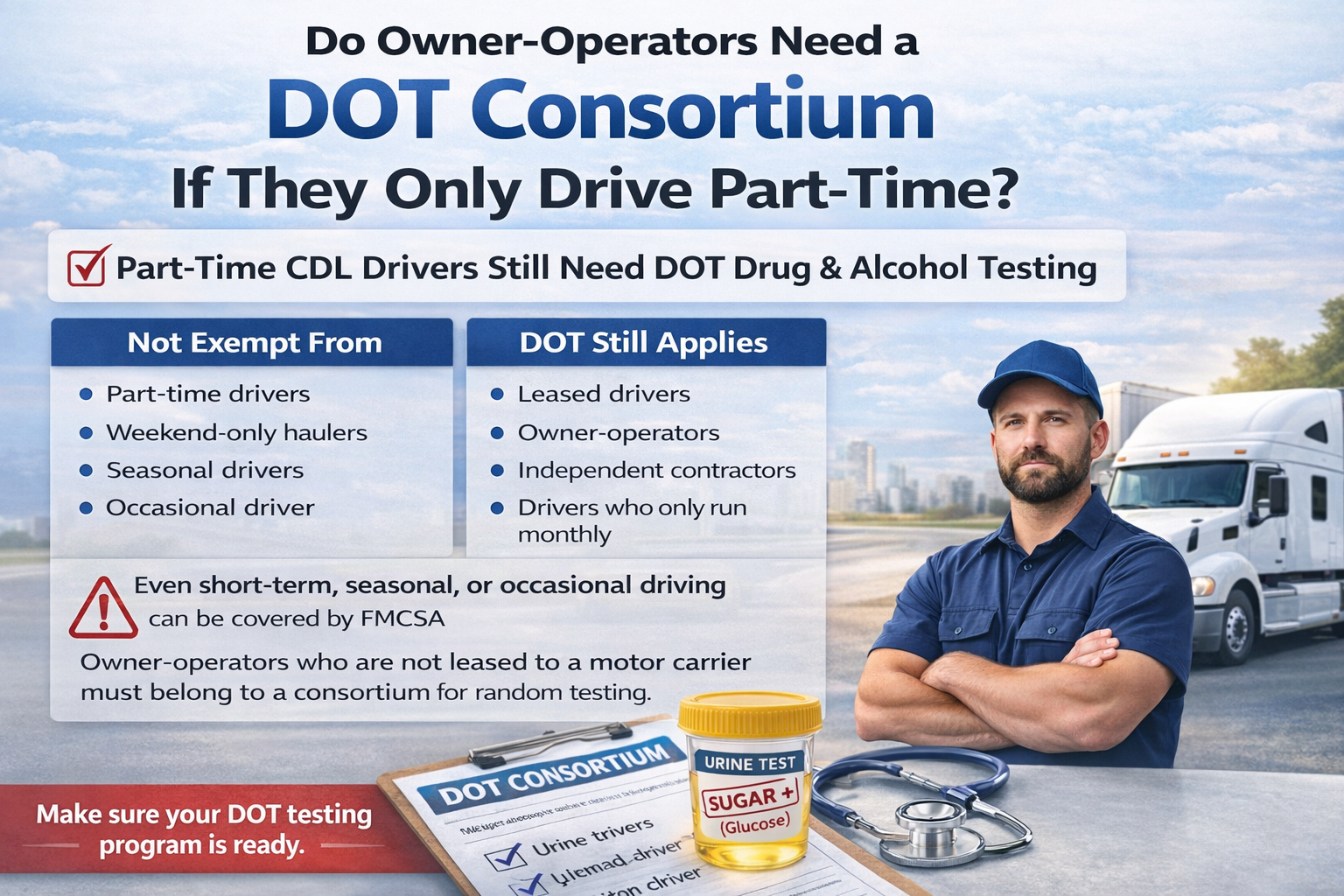
A very common question from CDL drivers is whether part-time, seasonal, weekend-only, or occasional driving changes the DOT drug and alcohol testing rules. For many owner-operators, the short answer is simple: if you operate a CDL-required commercial motor vehicle, FMCSA rules may still apply even if you only drive part-time.
Why this question causes confusion
Many drivers assume that driving only a few times a month, only during busy season, or only on weekends means they do not need to stay enrolled in a DOT drug and alcohol testing program. That assumption can create serious compliance problems.
FMCSA focuses on whether you are operating a covered commercial motor vehicle in a safety-sensitive role — not simply how often you drive. A driver does not become exempt just because the work is part-time or occasional.
What FMCSA says about part-time and occasional CDL drivers
FMCSA guidance explains that the term driver includes more than traditional full-time employees. It can include:
- Full-time drivers
- Casual drivers
- Intermittent or occasional drivers
- Leased drivers
- Independent owner-operator contractors
That means a company or owner-operator cannot rely on a “part-time” label alone to avoid FMCSA Part 382 requirements.
So do owner-operators need a consortium?
In many cases, yes. This is especially important for owner-operators who are not leased onto a motor carrier. FMCSA guidance specifically states that an owner-operator who is not leased to a motor carrier must belong to a consortium for random testing purposes.
Does FMCSA make exceptions for any of these situations?
Drivers often ask whether the rules change if they:
Common situations
Part-time driving, weekend-only hauling, seasonal work, temporary contracts, and occasional runs are all common scenarios where drivers assume they may be exempt.
Compliance reality
FMCSA does not treat those situations as automatic exceptions when the driver is operating a CDL-required CMV in commerce.
- A part-time driver
- A seasonal driver
- A driver who only works during peak months
- A driver who only moves loads occasionally
- An owner-operator who only drives a few times each month
What matters more than “part-time” status?
The better question is not “Am I full-time?” The better question is: Am I operating a commercial motor vehicle that requires a CDL and puts me under FMCSA drug and alcohol testing rules?
If the answer is yes, you need to make sure the required testing program is already in place before you drive.
| Situation | Likely DOT program impact | Why it matters |
|---|---|---|
| Owner-operator drives full-time | DOT program required | Covered CDL operations require compliance with Part 382. |
| Owner-operator drives part-time | DOT program still may be required | Part-time status alone does not create an exemption. |
| Seasonal or occasional driving | DOT program still may be required | Occasional and intermittent drivers can still be covered. |
| Owner-operator not leased to a carrier | Consortium required for random testing | FMCSA specifically addresses this situation. |
| Driver wants to start hauling again after time off | Program must be in place first | Compliance should be active before safety-sensitive work begins. |
What if an owner-operator is leased onto a motor carrier?
This is where details matter. In some leased arrangements, the motor carrier may control parts of the compliance program. But the driver should never assume coverage without confirming exactly how the drug and alcohol testing program is being handled.
The safest approach is to verify in writing who is responsible for consortium enrollment, random selections, test coordination, and recordkeeping.
Why staying enrolled year-round matters
Random testing programs are built around ongoing compliance, not last-minute enrollment after a load becomes available. Waiting until you get a job call can create problems because the testing program may not be properly established in time.
For owner-operators, staying enrolled helps show that the compliance system is already active when you need to operate.
Best practical advice for CDL drivers
- Do not assume “occasional” driving makes you exempt
- Confirm whether your vehicle and operation place you under FMCSA Part 382
- If you are not leased to a carrier, expect to need consortium enrollment for random testing
- Make sure the testing program is active before you perform safety-sensitive functions
- Keep your paperwork organized and current
Official FMCSA resources
- FMCSA: Are owner-operators who operate CMVs on public roads required to be enrolled in a controlled substances and alcohol testing program?
- FMCSA: Random Testing Guidance
- FMCSA: Applicability Guidance
- FMCSA: What tests are required and when does testing occur?
Bottom line
FAQ
Do owner-operators need a DOT consortium if they only drive part-time?
Usually yes, if they are operating a CDL-required CMV under FMCSA drug and alcohol testing rules. Part-time driving by itself does not create an exemption.
Does FMCSA make an exception for seasonal drivers?
Not simply because they are seasonal. FMCSA guidance includes casual, intermittent, and occasional drivers within the scope of covered operations.
What if I only haul on weekends?
Weekend-only work does not automatically remove Part 382 obligations if you are operating a covered CDL-required commercial motor vehicle.
Do owner-operators who are not leased to a motor carrier have to be in a consortium?
Yes. FMCSA guidance specifically says they must belong to a consortium for random testing purposes.
Can I wait to enroll only when I have a load booked?
That is risky. The safer approach is to have the required compliance program in place before performing safety-sensitive functions.
Need help with owner-operator DOT compliance?
HealthRoute helps owner-operators and motor carriers with DOT consortium enrollment, drug testing coordination, and compliance support in Orlando.
Call: 407-859-1880 • Location: 4985 Hoffner Ave, Suite 1, Orlando, FL 32812