Do CDL Drivers Have to Register for the FMCSA Clearinghouse?
Many CDL drivers hear about the FMCSA Drug & Alcohol Clearinghouse when applying for a job, dealing with a violation, or renewing their commercial driving privileges. One of the most common questions is: “Do I have to register?” The answer is not always — but in many real-world situations, registration becomes necessary.
What is the FMCSA Clearinghouse?
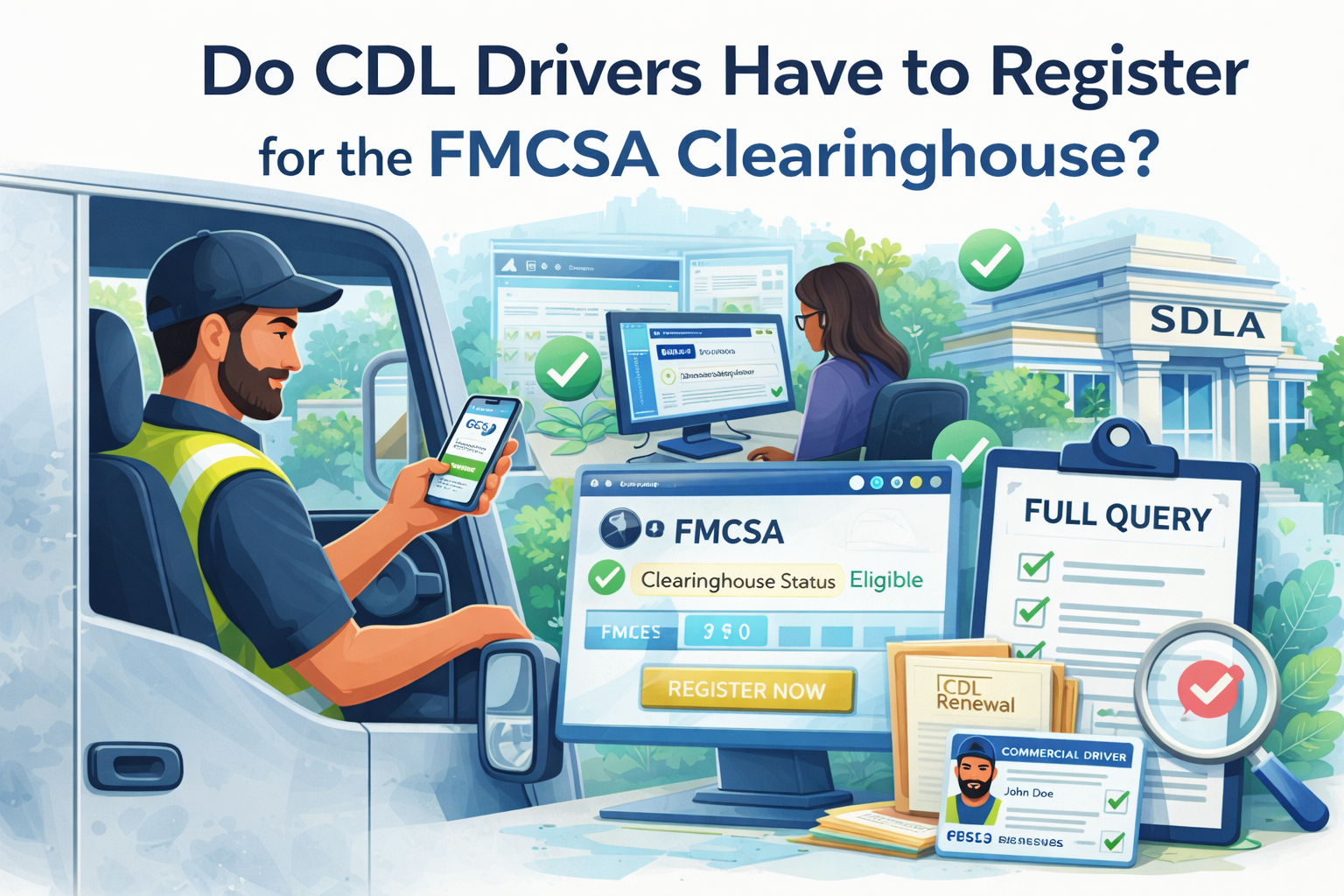
The FMCSA Drug & Alcohol Clearinghouse is a national online database used to track drug and alcohol program violations for drivers who hold a commercial driver’s license (CDL) or commercial learner’s permit (CLP) and are covered by FMCSA drug and alcohol testing rules.
It gives employers and government agencies access to information about drivers who may be prohibited from operating a commercial motor vehicle because of a DOT drug or alcohol violation.
Do all CDL drivers have to register?
No — not every CDL holder is required to register just because they have a CDL. FMCSA’s own guidance says drivers are not required to register for the Clearinghouse in every situation.
However, this is where many drivers get confused: while registration may not always be mandatory in theory, it is often necessary in practice.
- Give electronic consent for a full query
- Complete a pre-employment Clearinghouse check
- View their own Clearinghouse record online
- Track return-to-duty status after a violation
Why registration often matters in the real world
This is the key point for drivers: even though a CDL holder is not always legally required to register ahead of time, a prospective or current employer may need a full query of the driver’s Clearinghouse record.
A full query requires the driver’s electronic consent in the Clearinghouse. That means the driver must be registered to respond.
What about pre-employment?
Pre-employment is one of the biggest reasons drivers end up needing registration. Before a driver performs safety-sensitive functions for a new employer, that employer must complete the required Clearinghouse check.
If the employer needs a full pre-employment query, the driver must log in and provide consent electronically. Without registration, that process can stall hiring.
Who absolutely needs to use the Clearinghouse?
Employers
FMCSA-regulated employers use the Clearinghouse to run required queries and monitor drivers for drug and alcohol program violations.
Owner-Operators
Owner-operators generally must meet Clearinghouse requirements as both the employer and the driver, unless they operate under another employer’s authority.
Owner-operators are a very important group here because they are often responsible for both sides of compliance. In many cases, they must handle Clearinghouse obligations not just as drivers, but also as the employer.
Does the state check the Clearinghouse when a driver renews a CDL?
State Driver Licensing Agencies (SDLAs) use Clearinghouse information when determining whether a person can obtain, renew, keep, or reinstate commercial driving privileges.
This has become even more important under the Clearinghouse II rule. If a driver is in a prohibited status, the state can remove that driver’s commercial driving privileges until the return-to-duty process is completed.
| Situation | Does the driver need registration? | Why it matters |
|---|---|---|
| Simply holding a CDL or CLP | Usually no | Registration is not automatically required just because the person holds a commercial license. |
| Pre-employment full query | Yes | The driver must provide electronic consent in the Clearinghouse. |
| Viewing personal Clearinghouse record | Yes | The driver must register to log in and review record information online. |
| Owner-operator compliance | Usually yes | Owner-operators often have employer and driver responsibilities in the Clearinghouse. |
| Driver in prohibited status | Registration is strongly advisable | The driver may need to monitor status and complete steps related to the return-to-duty process. |
What happens if a driver has a Clearinghouse violation?
If a reportable DOT drug or alcohol violation is entered into the Clearinghouse, the driver may be placed in a status that prohibits them from performing safety-sensitive functions.
In that situation, the driver typically must complete the required return-to-duty process before driving again in a safety-sensitive role. This is also why being able to access and understand Clearinghouse status matters.
Official FMCSA resources
Here are the two official links you asked to include:
Bottom line
The best way to explain this to drivers is simple:
How this affects employers and owner-operators
For employers and owner-operators, this topic is not just about registration — it is about staying compliant with Clearinghouse query rules, annual checks, and drug and alcohol program requirements.
That is why many small fleets and owner-operators work with a consortium/TPA to help manage the program correctly.
FAQ
Do all CDL holders have to register for the FMCSA Clearinghouse?
No. Drivers are not automatically required to register just because they hold a CDL or CLP. But registration is needed for certain actions, such as giving electronic consent for a full query.
Do I need to register if I am applying for a new CDL job?
In many cases, yes. A full pre-employment query requires your electronic consent, and that means you need to be registered in the Clearinghouse.
Can I see my own Clearinghouse record without registering?
No. Drivers must register to log in and electronically view their own Clearinghouse information.
Do state agencies look at the Clearinghouse when I renew or keep my CDL?
Yes. State Driver Licensing Agencies use Clearinghouse information, and commercial driving privileges may be removed for drivers in a prohibited status until return-to-duty requirements are completed.
Do owner-operators have to register?
Usually yes, because owner-operators often have responsibilities as both the driver and the employer in the Clearinghouse system.
Need help with DOT compliance in Orlando?
HealthRoute helps drivers, owner-operators, and employers with DOT compliance services in Orlando, including drug testing, consortium enrollment, and support for navigating DOT program requirements.
Call: 407-859-1880 • Location: 4985 Hoffner Ave, Suite 1, Orlando, FL 32812