Overweight / BMI and the DOT Physical: Will I Fail My Medical Card?
A lot of CDL drivers worry there’s a “weight limit” for a DOT physical. The truth is: DOT medical certification is about safety and medical stability — not a single number on a scale. Here’s how BMI can matter, when sleep apnea screening comes up, and what you can do to prepare.
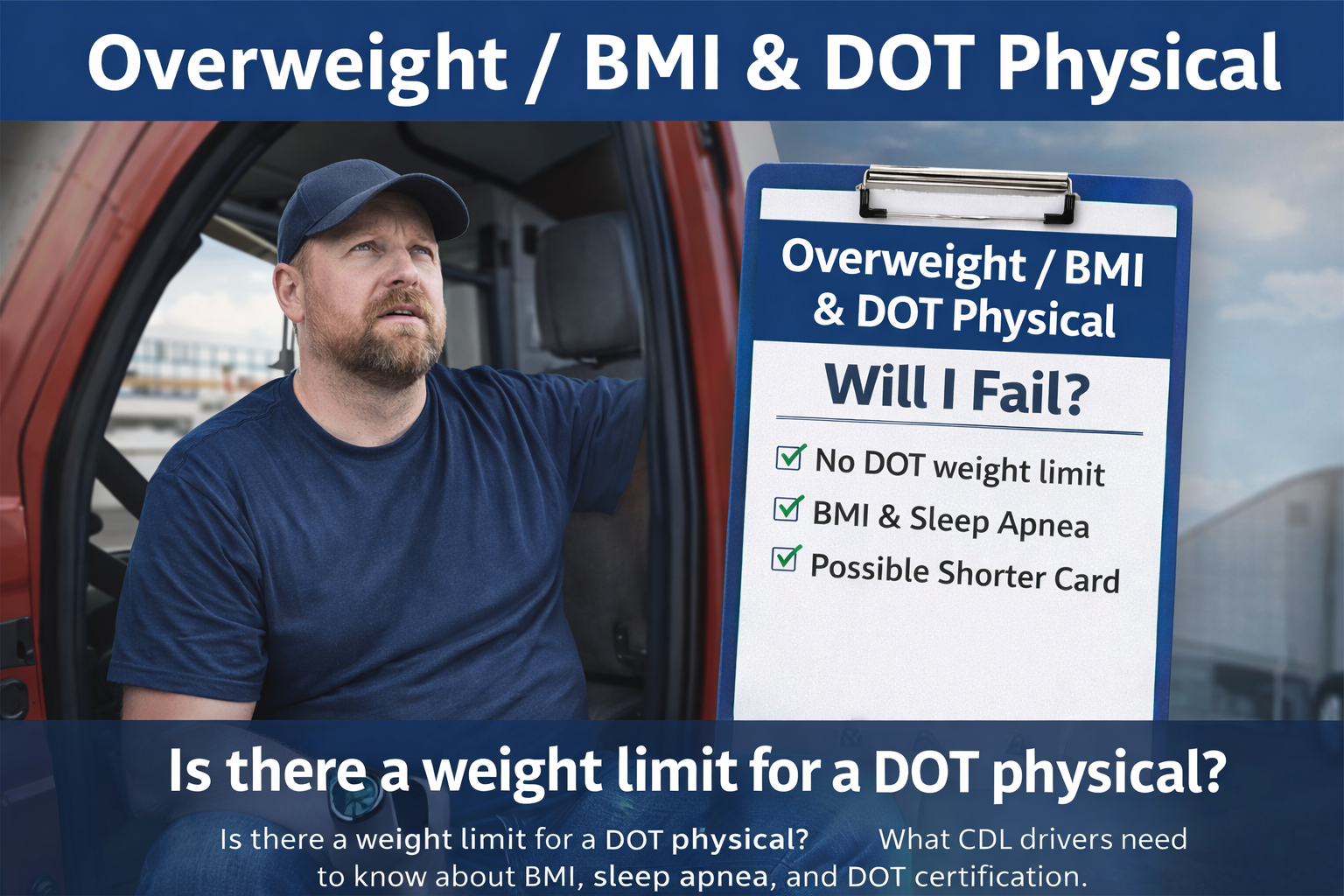
Is there a weight limit for a DOT physical?
No. DOT rules do not list a specific maximum weight that disqualifies a driver. Medical examiners focus on whether a driver has a condition that could cause sudden impairment, fatigue, or unsafe performance behind the wheel.
That said, higher body weight can be associated with conditions that examiners evaluate closely — especially sleep apnea, hypertension, and diabetes.
What is BMI and why do drivers hear about it?
BMI stands for Body Mass Index — a screening calculation based on height and weight. It’s not a perfect measure of health, but it’s often used as a quick “risk flag” for sleep apnea and other conditions.
Why BMI comes up in DOT exams
- Higher BMI can be associated with obstructive sleep apnea (OSA).
- OSA can cause daytime sleepiness and increase crash risk if untreated.
- Examiners may ask about symptoms and history to determine whether additional evaluation is needed.
Will I fail my DOT physical because I’m overweight?
Most drivers do not fail a CDL physical solely because of weight. What may happen instead is:
- You are certified normally (common when everything else is stable).
- You receive a shorter card (for closer follow-up) if there are risk concerns.
- Your exam is marked pending if the examiner needs additional testing or documentation (often sleep-related).
When does sleep apnea screening come up?
Sleep apnea is one of the main reasons BMI becomes part of the conversation. Medical examiners may ask additional questions if there are risk indicators such as:
- Loud snoring
- Witnessed breathing pauses during sleep
- Daytime sleepiness or fatigue
- High blood pressure
- Large neck circumference (often discussed as a risk factor)
- History of sleep apnea diagnosis
What outcomes are common?
| Scenario | What the examiner is thinking | What you do next |
|---|---|---|
| Higher BMI, no symptoms | Risk may be discussed, but certification is often possible if exam is normal. | Answer sleep questions honestly; follow up with PCP if advised. |
| Snoring + fatigue | Concern for undiagnosed sleep apnea. | May require sleep evaluation; exam could be pending until results. |
| Known sleep apnea on CPAP | Is treatment working and documented? | Bring CPAP compliance report and follow-up notes if requested. |
| High BP and/or diabetes present | Is the condition controlled and safe for driving? | Bring medication list, recent labs if available; you may receive a shorter card initially. |
How to prepare (without trying to “game” the exam)
The best preparation isn’t a crash diet — it’s being ready with the information examiners typically need.
- Medication list (name + dose + frequency)
- Glasses/contacts (and hearing aid if used)
- CPAP compliance report (if you have diagnosed sleep apnea)
- Recent A1C or diabetes labs (if you have diabetes or high blood sugar concerns)
- Blood pressure readings from home/pharmacy (optional but helpful if your BP runs high)
Common myths (and what’s actually true)
Myth: “If I’m overweight, I automatically fail.”
False. Weight alone isn’t an automatic disqualifier.
Myth: “BMI decides everything.”
BMI is a screening tool. The examiner looks at symptoms, history, and overall safety.
Myth: “Sleep apnea means no CDL.”
Not true. Many drivers are certified with sleep apnea when it’s treated effectively.
FAQ
What BMI # fails a DOT physical?
There isn’t a single BMI cutoff that automatically fails you. BMI may trigger additional questions or follow-up if sleep apnea risk is suspected.
Can I pass a DOT physical if I have sleep apnea?
Many drivers can, especially when treatment is effective. You may be asked for documentation (like a CPAP compliance report).
Do I need a sleep study to pass?
Not always. It depends on your risk factors, symptoms, and the examiner’s assessment. If a sleep study is needed, your exam may be pending until results are reviewed.
Need a DOT physical in Orlando?
If you’re worried about BMI, sleep apnea, blood pressure, or diabetes, call first — we’ll tell you what to bring and what helps. HealthRoute provides DOT physicals in Orlando with walk-in and appointment options.
Call: 407-859-1880 • Location: 4985 Hoffner Ave, Suite 1, Orlando, FL 32812
Related reading: Will I pass my DOT physical? • Sleep apnea DOT requirements