Automatic Failure of the FMCSA Safety Audit: What New Entrants Need to Know
Starting a new trucking company comes with a lot of moving parts — and one of the biggest early compliance risks is the FMCSA New Entrant Safety Audit. Certain violations can trigger an automatic failure, even if the carrier is brand new. Here’s what FMCSA looks for, why these failures happen, and how to protect your registration.
🎧 Listen to the Audio Summary
What is the New Entrant Safety Audit?
FMCSA places new motor carriers into the New Entrant Safety Assurance Program. As part of that process, the carrier must go through a safety audit to confirm that basic safety management controls are in place.
This is not something to take lightly. A failed audit can put a new carrier’s authority and registration at risk.
What can cause an automatic failure?
FMCSA identifies specific categories that can lead to an automatic failure of the safety audit. These are not minor paperwork issues. They are violations FMCSA treats as serious safety problems.
| Category | Examples that can trigger failure |
|---|---|
| Alcohol & Drug Violations | No alcohol and/or drug testing program, no random testing program, using a driver who refused a required test, using a driver known to have a BAC of 0.04 or greater, or using a driver with a disqualifying drug-test-related issue. |
| Driver Violations | Using a driver without a valid CDL, using a disqualified driver, using a driver with a revoked, suspended, or canceled CDL, or using a medically unqualified driver. |
| Operations Violations | Operating without required insurance or failing to require proper hours-of-service records or required ELD use where applicable. |
| Repair & Inspection Violations | Operating a vehicle placed out of service before repairs are made, failing to complete OOS repairs noted on DVIRs, or operating a CMV that has not been periodically inspected. |
Drug and alcohol program failures are a major problem
One of the most common trouble spots for new carriers is the DOT drug and alcohol testing program. FMCSA expects covered employers to have a compliant program in place — not just a plan to set one up later.
- A written DOT drug and alcohol policy
- A pre-employment drug test process
- A random drug and alcohol testing program
- Required driver acknowledgments and educational materials
- Clear records showing the program is active and compliant
For owner-operators and small fleets, this is one reason consortium enrollment is so important. If FMCSA asks for proof and the program is not in place, that can become a serious audit issue fast.
Driver qualification mistakes can also sink the audit
A new carrier cannot use drivers who are not properly qualified. That includes drivers who do not have a valid CDL when one is required, drivers who are disqualified, drivers with a suspended or revoked CDL, or drivers who are medically unqualified.
Operations violations: insurance, ELDs, and hours of service
FMCSA also looks at whether the carrier is operating with the required level of insurance and whether drivers are being required to keep proper hours-of-service records. That includes ELD use when required.
Insurance
A carrier must have the required level of insurance in effect. Running a CMV without it can be an automatic-failure issue.
Hours of Service / ELD
FMCSA expects carriers to require proper hours-of-service records and, where applicable, proper use of required electronic logging devices.
Repair and inspection violations matter more than many carriers realize
New entrants also get into trouble when they keep operating equipment that should not be on the road. FMCSA pays attention to out-of-service conditions and inspection compliance.
- Do not operate a vehicle that has been placed Out of Service until repairs are made.
- Do not ignore OOS repair issues documented on a DVIR.
- Do not operate a CMV that has not had its required periodic inspection.
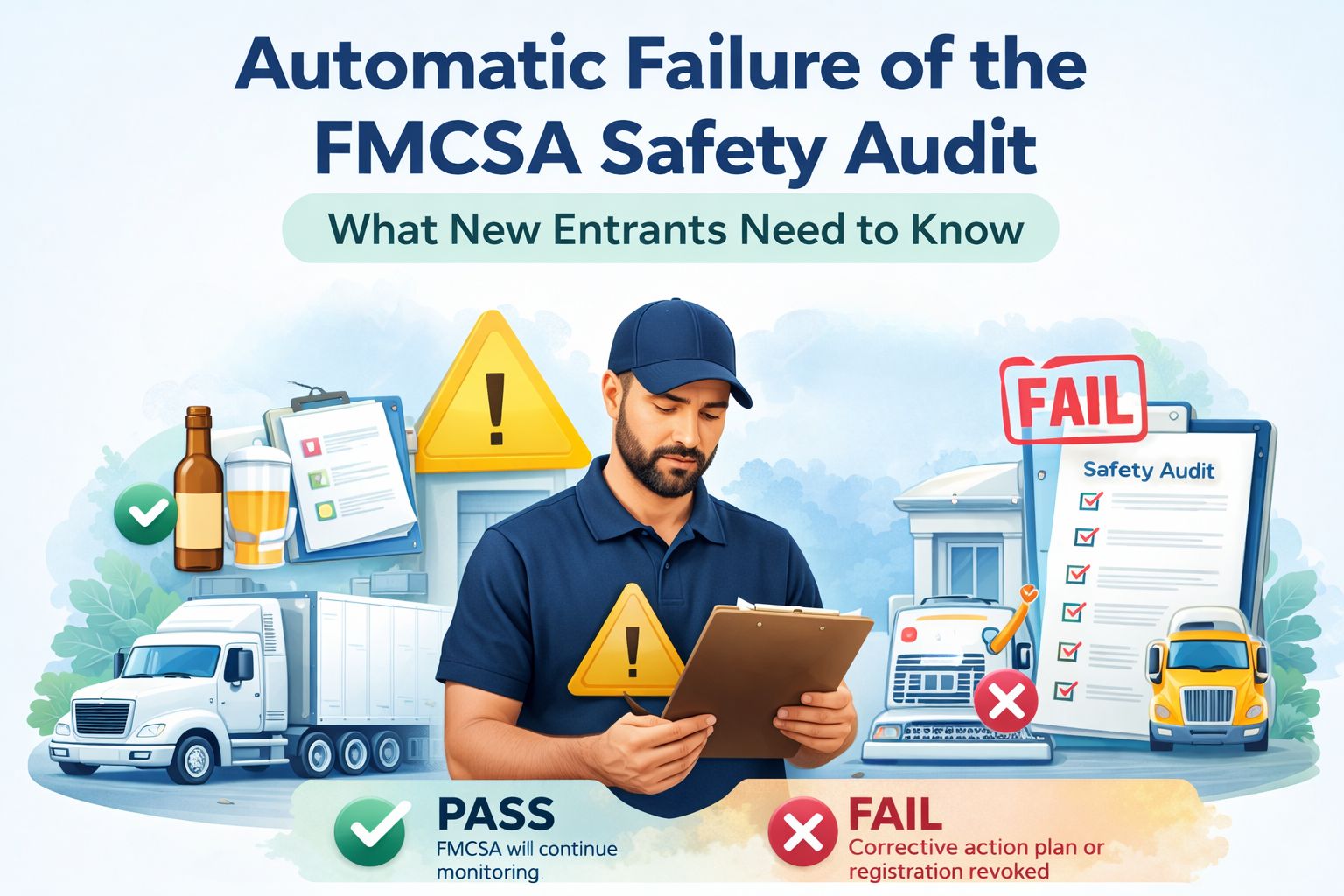
What happens if the carrier passes?
If the new entrant passes the safety audit, FMCSA continues monitoring safety compliance and performance during the new entrant period. Passing does not mean the carrier can relax — it means the basic controls were acceptable at the time of audit.
What happens if the carrier fails?
If the carrier fails the safety audit, FMCSA expects the carrier to submit an acceptable corrective action plan. If the problems are not corrected, FMCSA can revoke the carrier’s new entrant registration.
How new entrants can avoid an automatic failure
- Drug and alcohol testing program documents
- Random testing program enrollment, if required
- Pre-employment drug test compliance
- Valid CDL and medical qualification records for drivers
- Insurance in effect
- Hours-of-service and ELD compliance records
- DVIR and repair documentation
- Periodic vehicle inspection records
FAQ
Can a new entrant fail the audit just for not having a random testing program?
Yes. FMCSA lists the absence of a required random drug and alcohol testing program as one of the automatic-failure issues for new entrants.
Can a medically unqualified driver cause an automatic failure?
Yes. Using a medically unqualified driver is one of the serious driver qualification problems FMCSA treats as an automatic-failure issue.
Does operating without insurance affect the safety audit?
Yes. Operating a motor vehicle without the required level of insurance is one of the violations that can trigger an automatic failure.
What if the carrier fails the audit?
The carrier must submit an acceptable corrective action plan. If the issues are not corrected, FMCSA can revoke the new entrant registration.
Need help getting audit-ready?
HealthRoute helps new motor carriers, employers, and owner-operators with practical compliance support, including DOT drug and alcohol program setup, consortium enrollment, driver onboarding paperwork, and general DOT compliance guidance.
Call: 407-859-1880 • Email: [email protected] • Location: 4985 Hoffner Ave, Suite 1, Orlando, FL 32812